
RCBJ Spotlight
The 2026 EB-5 Rule: What Is Changing and What to Watch
By: Mine Ekim, Managing Director, Legal & Head of Investor Experience | Civitas Capital Group
This article originally appeared in the Fall 2026 edition of IIUSA’s Regional Center Business Journal
Read the full Fall 2026 RCBJ
Register for IIUSA’s webinar on the fee change
Introduction
On September 30, 2026, the Department of Homeland Security (DHS) published a final rule resetting the fees for EB-5 filings (the Final Rule).[1] U.S. Citizenship and Immigration Services (USCIS) announced the rule the day before, explaining that it is updating EB-5 fees “to ensure EB-5 fees fully recover the cost of operating the program, meet statutory processing time goals, and support integrity measures such as audits and site visits.”[2] The new fees apply to filings postmarked on or after November 30, 2026, and follow a period of uncertainty that began when a federal court stayed the April 2024 EB-5 fee increases.[3]
The Final Rule does more than adjust filing fees. It introduces a new Form I-527, Amendment to Legacy Form I-526, for certain legacy investors, codifies the EB-5 Integrity Fund fees and late-payment penalties, and clarifies when spouses and children must file their own petitions to remove conditions. This article summarizes those changes and highlights the practical points that investors, regional centers, and practitioners should keep in mind as the new schedule approaches.
I. From Court Stay to Final Rule
The EB-5 Reform and Integrity Act of 2022 (RIA) requires DHS to conduct an EB-5-specific fee study and authorizes it to set fees that recover the full cost of administering the program and support statutory processing goals.[4] DHS instead adjusted EB-5 fees in its general fee rule that took effect on April 1, 2024. On November 12, 2025, the U.S. District Court for the District of Colorado stayed those EB-5 fees in Moody v. Noem, concluding that the RIA precluded DHS from adjusting EB-5 fees in that rule.[5] USCIS reverted to the fees in effect before April 1, 2024. In the Final Rule, DHS and USCIS state that they believe the decision is incorrect but have implemented it, and that USCIS is not required to refund the higher 2024 fees.[6]
The Final Rule rests on the EB-5-specific fee study that the RIA requires. The revised USCIS fee study projects annual EB-5 program costs of approximately $105 million against approximately $56.6 million in revenue under the current fees, a gap of approximately $48.4 million. DHS estimates that the new schedule will affect about 16,600 filings each year and increase form fees by about 70.7 percent on a weighted-average basis.[7]
II. The New Fee Schedule
Table 1 compares the fees currently in effect with the fees under the Final Rule.[8]
Table 1: EB-5 Fees Before and After November 30, 2026
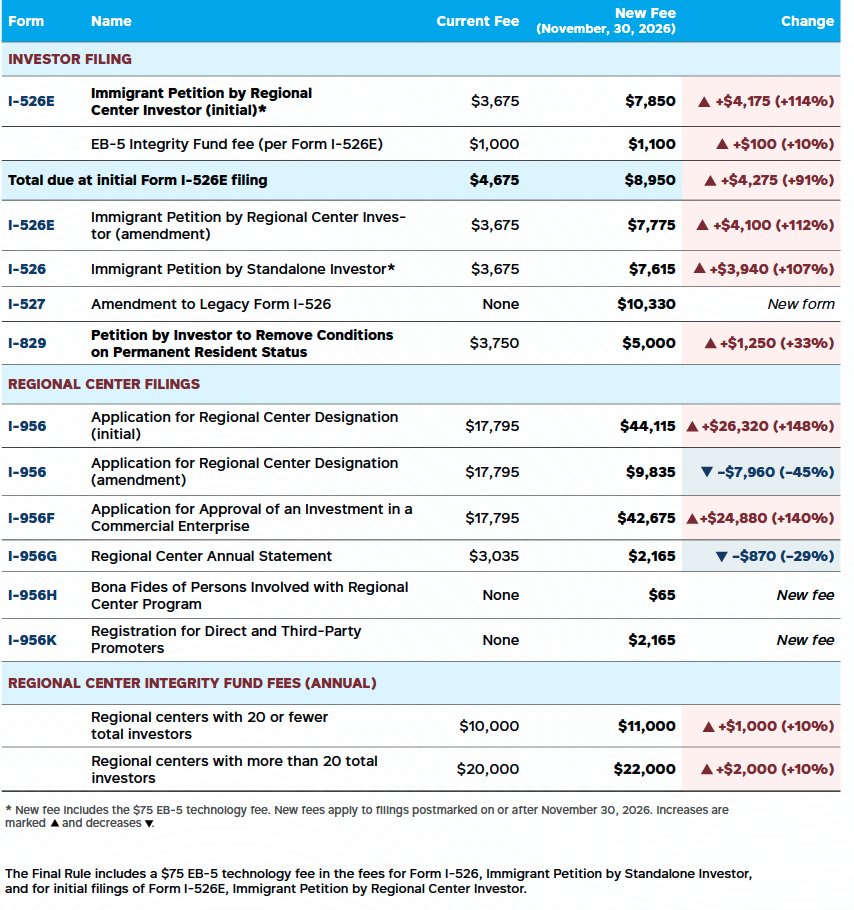
The Final Rule includes a $75 EB-5 technology fee in the fees for Form I-526, Immigrant Petition by Standalone Investor, and for initial filings of Form I-526E, Immigrant Petition by Regional Center Investor. Amendments to Form I-526E do not carry it, which explains why some published summaries cite $7,850 and others cite $7,775.[9] For a regional center investor, the I-526E fee and the EB-5 Integrity Fund fee together rise from $4,675 to $8,950 at initial filing. These fees are paid once per petition. Derivative family members do not file their own Form I-526E, although they may incur separate fees later in the process.
Two features of the schedule stand out:
- First, the final investor fees are lower than both the October 2025 proposal and the fees that applied from April 2024 until the court stay. The final I-526E fee of $7,850 is $1,775 below the $9,625 DHS proposed and well below the 2024 fee of $11,160, and the final $5,000 fee for Form I-829, Petition by Investor to Remove Conditions on Permanent Resident Status, is $2,860 below the proposal and well below the 2024 fee of $9,525.[10]
- Second, the regional center fees moved in the opposite direction. The fees for initial filings of Form I-956, Application for Regional Center Designation, and Form I-956F, Application for Approval of an Investment in a Commercial Enterprise, are now more than $12,000 above the October 2025 proposal, although they remain below the 2024 levels of $47,695. By contrast, the fees for Form I-956 amendments and for Form I-956G, Regional Center Annual Statement, decrease. DHS explains that it continues to recover the cost of regional center terminations and reaffirmations through the initial Form I-956 and Form I-956F fees, rather than charging a fee at the point of termination.[11]
III. EB-5 Integrity Fund Fees and Late-Payment Penalties
The Final Rule increases each EB-5 Integrity Fund fee by 10 percent, based on inflation between 2022 and 2025, and codifies the payment and penalty framework in the regulations.[12] The annual regional center fee is due on October 1 of each year: $22,000, or $11,000 for a regional center with 20 or fewer total investors in its new commercial enterprises as of the last day of the preceding fiscal year. No penalty applies to a payment made by October 31. A payment made between November 1 and November 30 carries a penalty of 10 percent of the required fee, and a payment made between December 1 and December 30 carries a penalty of 20 percent. If the fee and any penalty remain unpaid after December 30, USCIS will terminate the regional center’s designation. Termination is not immediate, however. USCIS will first issue a notice of intent to terminate and give the regional center an opportunity to show that it paid the correct amount on time, and a termination may be appealed.[13] Because the Final Rule is scheduled to take effect on November 30, 2026, after this year’s October 1 payment date, the higher regional center amounts would ordinarily first apply to the annual payment due on October 1, 2027. The Final Rule does not address that transition expressly, however, and regional centers paying late in the current cycle should confirm with counsel how the new provisions apply.
IV. Form I-527 for Legacy Investors
The new Form I-527 implements a statutory protection for investors who filed their petitions before the RIA was enacted on March 15, 2022. It allows those investors to amend a pending petition when their regional center is terminated or their new commercial enterprise or job-creating entity is debarred, so that they may seek to preserve their eligibility.[14] The final fee is $10,330, higher than the $8,000 DHS proposed. DHS has confirmed that USCIS will not treat a Form I-527 as a new petition, so the investor retains the original priority date, and that there is no penalty for seeking relief. DHS has also stated that it will reconsider the Form I-527 fee when more data become available, and that, under USCIS policy, a legacy investor may generally remain eligible without a Form I-527 if the project is complete or will be completed with sufficient job creation for all investors.[15]
V. Form I-829 Rules for Spouses and Children
The Final Rule also revises the regulation governing petitions to remove conditions.[16] An investor may include a spouse and children on the investor’s Form I-829. If the investor does not include them, each spouse and child must file a separate petition, and may do so at any time during the period when the investor is required to file. The same approach applies to a child who turned 21 or married, and to a former spouse, during the period of conditional residence. If the investor is deceased, or does not file at all, the spouse, former spouse, or children may still seek to remove conditions by establishing eligibility and filing within the period when the investor would have been required to file. For families whose circumstances have changed since the initial petition, these provisions add welcome clarity, and each separate petition carries the new $5,000 fee.
VI. Practical Considerations
The applicable fee depends on the postmark date of a complete filing, not on the date of the investment. A filing postmarked on or after November 30, 2026, must include the new fees. A filing postmarked before that date pays the current fees, and petitions and applications already filed are not affected by the change. Before filing, the fee should be confirmed against USCIS Form G-1055, Fee Schedule, which has been revised to reflect the new amounts, and against the current edition of the form and its instructions.[17] Because November 29, 2026, falls on a Sunday, the last practical day to postmark a filing at the current fees is Saturday, November 28. With the Thanksgiving holiday falling that same week, many filers will want to file well before then. Investors should not, however, rush an incomplete petition to beat the deadline, because the cost of a deficient filing can far exceed the fee difference. That caution carries more weight under USCIS policy guidance issued in August 2026, which restores officers’ discretion to deny a benefit request that lacks required initial evidence without first issuing a Request for Evidence or Notice of Intent to Deny.[18]
Conditional residents whose 90-day filing window for Form I-829 opens before November 30 may file at the current $3,750 fee if the petition is postmarked before that date. Regional centers should budget for the higher fees for initial Form I-956 and Form I-956F filings and should calendar the October 1 Integrity Fund payment to avoid the new penalty tiers. Promoters registering on Form I-956K, Registration for Direct and Third-Party Promoters, will pay a new $2,165 fee. Each person filing Form I-956H, Bona Fides of Persons Involved with Regional Center Program, will pay a new $65 fee.
Investors should also keep a second date in view. Under the RIA, the minimum investment amounts of $800,000 and $1,050,000 are scheduled for their first inflation adjustment on January 1, 2027.[19] USCIS has not yet published the adjusted amounts. The Final Rule does not address that adjustment, but for many investors the change in the required investment will outweigh the change in filing fees.
VII. What to Watch
Several developments could still shape how the new schedule operates. First, the Final Rule addresses the possibility of further litigation directly. DHS states that its provisions are severable, so that a court could stay or enjoin a particular fee, such as the Integrity Fund penalties, without affecting the remaining fees.[20] Given the history that led to this rule, stakeholders should follow any legal challenge closely.
Second, the new fees depend heavily on USCIS’s workload projections. The revised fee study assumes 8,500 Form I-526E receipts each year in fiscal years 2026 and 2027, up from 3,500 in the proposed rule.[21] If actual filings fall short of that forecast, revenue will fall short as well, and future fee adjustments may follow. DHS has stated that it will continue to monitor the effect of the fees on program participation and processing times.
Third, the Final Rule assumes that Congress will reauthorize the Regional Center Program beyond its current September 30, 2027, expiration.[22] The fee schedule, the Integrity Fund, and the Form I-527 framework all operate within that authorization, and the reauthorization debate will shape the program’s cost structure going forward.
Conclusion
The Final Rule responds to the court stay with a fee schedule grounded in an EB-5-specific study, as the RIA requires. The Form I-526 and Form I-526E fees are lower than in 2024 but more than double the reinstated fees, while regional centers face significantly higher costs for initial designations and project applications. The Form I-527 and the clarified Form I-829 rules respond to long-standing practical questions for legacy investors and families.
The new fees remain subject to any future litigation or agency action. In the meantime, investors and regional centers should confirm the applicable fee for every filing, plan around both November 30, 2026, and January 1, 2027, and treat the fee schedule as one part of a broader compliance and planning conversation.
[1] Department of Homeland Security, U.S. Citizenship and Immigration Services Employment-Based Immigrant Visa, Fifth Preference (EB-5) Fee Rule, 91 Fed. Reg. 61940 (Sept. 30, 2026) (to be codified at 8 C.F.R. pts. 106, 216) [hereinafter Final Rule], https://www.federalregister.gov/d/2026-20016.
[2] U.S. Citizenship and Immigration Services, USCIS Adjusts EB-5 Fees to Cover Program Costs and Strengthen Integrity Measures (Sept. 29, 2026), https://www.uscis.gov/newsroom/alerts/uscis-adjusts-eb-5-fees-to-cover-program-costs-and-strengthen-integrity-measures.
[3] Moody v. Noem, No. 24-cv-00762-CNS, 2025 WL 3157554 (D. Colo. Nov. 12, 2025) (originally filed as Moody v. Mayorkas).
[4] EB-5 Reform and Integrity Act of 2022, Consolidated Appropriations Act, 2022, Pub. L. No. 117-103, div. BB, § 106(b)–(c), 136 Stat. 49, 1070 (2022); Final Rule, supra note 1, at 61940.
[5] Moody, supra note 3; Final Rule, supra note 1, at 61941, 61944.
[6] Final Rule, supra note 1, at 61956.
[7] Id. at 61941, 61943.
[8] Id. at 61942–61943 (Table 1). The current fees are those USCIS reinstated following the court’s November 12, 2025, decision.
[9] Final Rule, supra note 1, at 61952; 8 C.F.R. § 106.2(d)(2)(iii) (effective Nov. 30, 2026).
[10] Final Rule, supra note 1, at 61942–61943, 61946 (Tables 1 and 2); Department of Homeland Security, U.S. Citizenship and Immigration Services Employment-Based Immigrant Visa, Fifth Preference (EB-5) Fee Rule, 90 Fed. Reg. 48516, 48517 (proposed Oct. 23, 2025), https://www.federalregister.gov/d/2025-19642.
[11] Final Rule, supra note 1, at 61951.
[12] INA § 203(b)(5)(J), 8 U.S.C. § 1153(b)(5)(J); Final Rule, supra note 1, at 61952.
[13] 8 C.F.R. § 106.2(d)(10) (effective Nov. 30, 2026); Final Rule, supra note 1, at 61985.
[14] INA § 203(b)(5)(M), 8 U.S.C. § 1153(b)(5)(M).
[15] Final Rule, supra note 1, at 61956–61958.
[16] 8 C.F.R. § 216.6(a)(1)(ii) (effective Nov. 30, 2026); Final Rule, supra note 1, at 61985.
[17] Final Rule, supra note 1, at 61941.
[18] U.S. Citizenship and Immigration Services, Policy Alert PA-2026-05, Evidence, Requests for Evidence, and Notices of Intent to Deny (Aug. 5, 2026); see 8 C.F.R. § 103.2(b)(8).
[19] INA § 203(b)(5)(C), 8 U.S.C. § 1153(b)(5)(C).
[20] Final Rule, supra note 1, at 61945.
[21] Id. at 61947 (Table 3).
[22] Id. at 61940 n.1.