
EB-5 Investment Amount in 2027: $937,500, $900,000, or $850,000? (RCBJ Spotlight)
By Adam Greene, Executive Vice President, EB-5 Programs, Peachtree Group
This article originally appeared in the Fall 2026 edition of IIUSA’s Regional Center Business Journal
Read the full Fall 2026 RCBJ
Short answer: The minimum EB-5 investment is $800,000 for targeted employment area (TEA) and infrastructure projects and $1,050,000 for all other “standard” projects. Both amounts will increase automatically for inflation on January 1, 2027. Depending on how U.S. Citizenship and Immigration Services (USCIS) reads the law, the new TEA amount will most likely be $937,500, $900,000, $862,500, or $850,000, and the new amount for standard projects will mostly likely be $1,250,000, $1,200,000, or $1,150,000. USCIS has not yet published the official figures.
For months, I told anyone who would listen that the TEA amount would rise to $937,500 in 2027. I thought it was black letter law. Two recent USCIS publications changed my mind. Here is what we know, what we do not, and why.
How the RIA Inflation Adjustment Works
The EB-5 Reform and Integrity Act of 2022 (RIA) set the current amounts in March 2022: $1,050,000 for a standard project and $800,000 for a project in a targeted employment area (a rural or high-unemployment area) or a qualifying infrastructure project. The RIA requires these amounts to be adjusted automatically on January 1, 2027, and every five years thereafter, for petitions filed on or after each adjustment date.
The standard amount is adjusted by the “cumulative annual percentage change” in the unadjusted Consumer Price Index for All Urban Consumers (CPI-U) between January 1, 2022, and the date of adjustment, and rounded down to the nearest $50,000. The TEA and infrastructure amount is then set at 75% of the adjusted standard amount. The Secretary of Homeland Security publishes the new amounts in the Federal Register.
The Literal Calculation: $937,500
The most literal reading compares the CPI-U in effect on January 1, 2022 (the December 2021 index, 278.802) with the most recent index before the adjustment. The September 2026 index, released by the Bureau of Labor Statistics on October 14, 2026, is 336.940, a 20.9% increase. That takes $1,050,000 to about $1,269,000, which rounds down to $1,250,000. Seventy-five percent of $1,250,000 is $937,500.
Under this method, the standard amount is essentially locked in: prices would have to fall about 1.5% before year-end to drop it to $1,200,000, or rise to about 2.5% to push it to $1,300,000.
Will USCIS Round the TEA Amount Down to $900,000?
On July 2, 2026, USCIS published a notice of proposed rulemaking (NPRM) to implement the RIA. The NPRM’s preamble says USCIS will take 75% of the standard amount and then also round that figure down to the nearest $50,000. That second round-down turns $937,500 into $900,000.
The proposed regulatory text, which is what would actually become binding, does not say that. It rounds down the standard amount but says only that the TEA amount will equal 75% of the standard amount. By contrast, the new high employment area tier in the same section is expressly “rounded up to the nearest $50,000,” so USCIS knows how to write a rounding instruction when it wants one.
To be fair, the statute’s rounding sentence, although it appears in the provision describing the standard amount, refers to “qualifying investment amounts” in the plural. USCIS may be relying on that language to round the TEA and infrastructure amount as well, even though the separate provision requiring the 75% calculation is silent on rounding.
What Does “Cumulative Annual Percentage Change” Mean?
The phrase could mean the change from a starting month to an ending month, or the change between periodic averages. USCIS recently used averages to measure inflation in another EB-5 rule, which raises the possibility it will do the same here.
In its October 2025 proposed EB-5 fee rule, USCIS considered three methods for adjusting EB-5 Integrity Fund fees for inflation (90 FR 48532, nn. 56–60):
- Half-year averages: first half of 2022 (288.347) to first half of 2024 (312.145), an 8.25% increase. USCIS proposed this method because it avoids month-to-month swings.
- Month to month: March 2022 (287.504) to November 2024 (315.493), a 9.74% increase.
- June to June: June 2022 (296.311) to June 2024 (314.175), a 6.03% increase, mirroring how Congress directed USCIS to adjust premium processing fees.
In the final EB-5 fee rule published September 30, 2026, USCIS raised Integrity Fund fees by 10%, which matches the change from the full-year 2022 average CPI-U (292.655) to the full-year 2025 average (321.943). Averaging matters because inflation ran hot during 2022; averaging over that year raises the starting point and shrinks the cumulative increase.
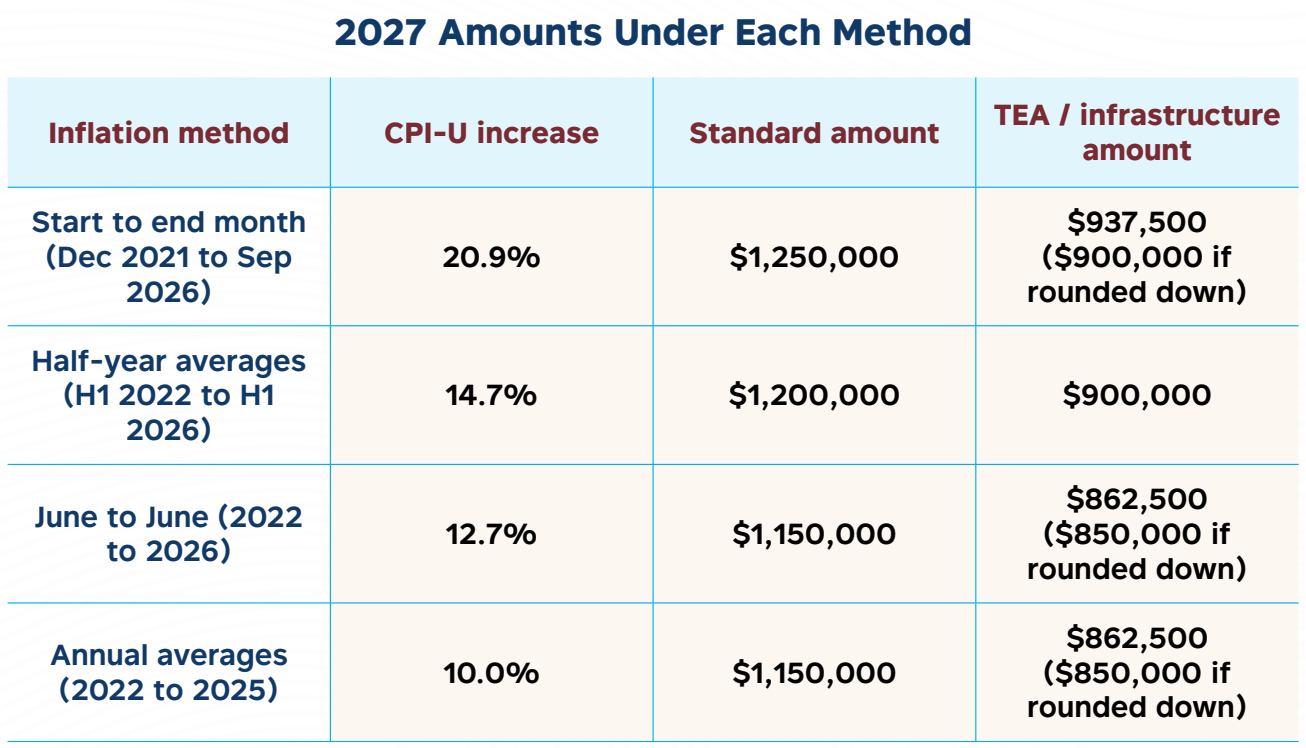
Source: Peachtree Group calculations using unadjusted CPI-U (series CUUR0000SA0) from the Bureau of Labor Statistics.
Substituting the 2026 annual average would not change the annual-average result unless prices jump sharply in the last three months of the year, and that average will not be published until mid-January 2027, after the adjustment date.
Outlook
The 2027 TEA amount could be $937,500, $900,000, $862,500, or $850,000. The NPRM says USCIS will decide when it finalizes the rule whether to include the adjusted amounts for petitions filed on or after January 1, 2027. As of October 14, 2026, USCIS has not published the adjusted amounts in the Federal Register.
Our view is that the TEA amount is unlikely to fall below $900,000, and we believe much of the industry shares that view. We do not believe Congress intended an averaging method that removes a large part of the inflation it was trying to capture. But I was surprised once already.
What is certain is that under every method we evaluated, the TEA amount rises by at least $50,000, and possibly by as much as $137,500. Investors who want to lock in the $800,000 amount should file before January 1, 2027, which is now less than three months away.